Title: The molecular mechanisms of the ShosTA system in mediating anti-phage defense
Rong Yang+, Libang He+, Zhuoxi Wu, Ruiwen Wang, Hao Guo, Ruifang Yuan, Huiling Su, Guodong Chen, Faxiang Li*
Abstract
The ShosTA system, a two-component toxin-antitoxin (TA) system consisting of the ShosT and ShosA proteins, has recently been shown to mediate anti-phage defense. However, the molecular mechanisms underlying this system’s role in anti-phage defense remain elusive. Here, we first confirmed that ShosT functions as the toxic component that induces cell death, while ShosA acts as the antitoxin to neutralize these toxic effects. We then solved the crystal structures of apo-ShosT, ShosA, and the ShosT-PRPP (phosphoribosyl pyrophosphate) complex. The structural
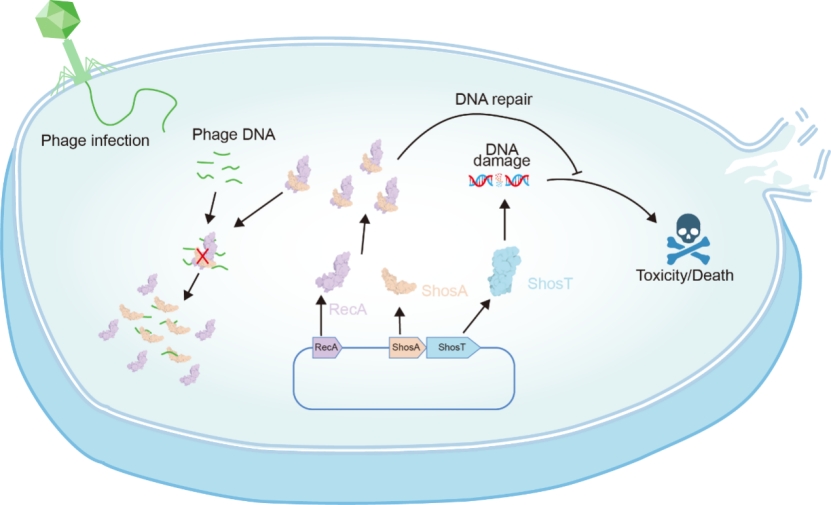
data reveal that while ShosT contains a PRTase (phosphoribosyl-transferase) domain, it possesses unique noncanonical features; furthermore, we demonstrate that its binding to PRPP is indispensable for its toxic activity. ShosA is a DprA-like protein that functions as a homodimer. Both its ssDNA-binding and dimerization abilities are essential for its antitoxin activity. Further biochemical and structural studies demonstrate that ShosA directly binds to RecA, an interaction that is essential for neutralizing ShosT. The ShosA–RecA interaction is sensitive to the presence
of ssDNA, implying that ShosTA-mediated abortive infection (Abi) may be triggered by the invading phage DNA. Our studies uncovered the mechanisms of ShosT inducing cell death and ShosA antagonizing the toxic effects of ShosT in anti-phage defense.
Link:https://doi.org/10.1093/nar/gkag197






 No.172, Tongzipo Road,Changsha City,Hunan
  0731-89665629
  life_csu@163.com