Title: Alterations in PD-L1 succinylation shape anti-tumor immune responses in melanoma
Long Liang#, Xinwei Kuang#, Yi He#, Lin Zhu, Poyee Lau, Xin Li, Dingan Luo, Lan Gong, Wenbin Zhou, Fanglin Zhang, Xiaowei Liang, Zhuofeng Li, Bin Hu, Dandan Liu, Tao Ding, Hui Li, Shuang Zhao, Juan Su Mien-Chie Hung, Jing Liu✉, Hong Liu✉, Xiang Chen,✉
Abstract
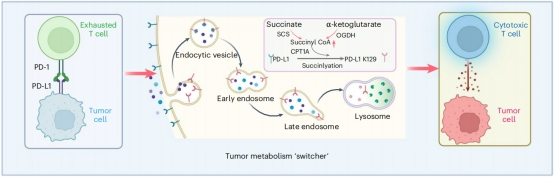
Tumors undergo metabolic reprogramming to meet the energetic, synthetic and redox demands essential for malignancy, often characterized by increased glycolysis and lactate production. However, the role of mitochondrial metabolism in tumor immunity remains unclear. The present study integrates spatial transcriptomics, bulk transcriptomics and proteomics, revealing a strong link between the metabolite succinyl-CoA and tumor immunity as well as the efficacy of anti-programmed cell death protein-1 (PD-1) therapy in patients with melanoma. Elevated succinyl-CoA levels, through α-ketoglutarate or succinate supplementation, enhanced T cell-mediated tumor elimination, both in vitro and in vivo. Mechanistically, succinylation of the ligand of PD-1 (PD-L1) at lysine 129 led to its degradation. Increased carnitine palmitoyltransferase 1A (CPT1A), identified as a succinyltransferase for PD-L1, boosted anti-tumor activity. Preclinically, bezafibrate, a hyperlipidemia drug, upregulated CPT1A and synergized with CTLA-4 monoclonal antibody to inhibit tumor growth. Clinically, higher PD-L1 and lower CPT1A levels in tumors correlated with better anti-PD-1 therapy responses, suggesting potential biomarkers for prediction of treatment efficacy.
Link: https://pmc.ncbi.nlm.nih.gov/articles/PMC11906371/






 No.172, Tongzipo Road,Changsha City,Hunan
  0731-89665629
  life_csu@163.com